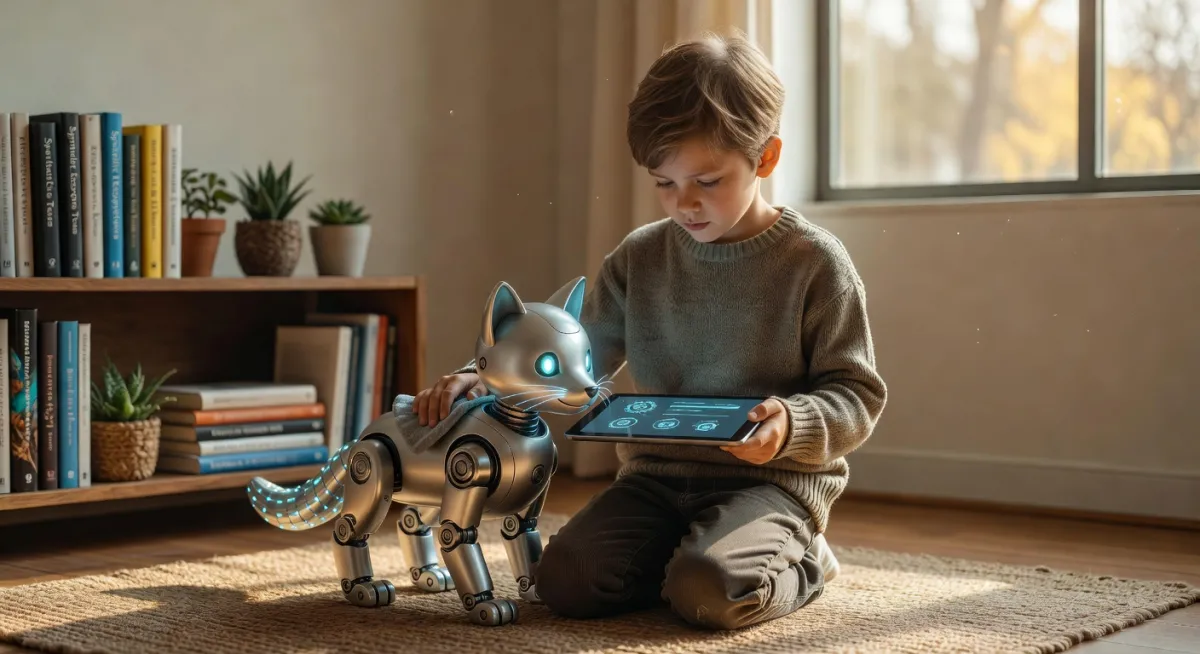
A stuffed bear sits silently on a shelf. A robot dog tilts its head, blinks, and waits. A child says "hello" — and the robot says it back. Something switches on in the child's brain at that moment that no passive toy can trigger. That moment of contingent response — when a toy reacts specifically to what you just did — sits at the heart of why interactive robots represent something genuinely new in the landscape of children's play.
What Makes a Robot Toy "Interactive" in a Meaningful Sense?
Not every toy with lights and sounds qualifies. A toy that plays a pre-recorded melody when you press a button is reactive in the most basic sense, but it isn't truly interactive. Meaningful interactivity requires contingency: the robot's response depends on what the child just did, said, or expressed. Modern programmable and responsive robots achieve this through a combination of sensors — touch, sound, light, and sometimes even facial recognition — paired with onboard processors that select behaviors based on input.
A robot might lower its head and slow its movements when spoken to softly, speed up and flash bright colors when a child claps, or express simulated frustration if repeatedly poked. These responses aren't random. They're designed to mirror the turn-taking logic of real social exchange, which is precisely what makes them developmentally interesting.

As an Amazon Associate, I earn from qualifying purchases.
The Developmental Science Behind Contingent Interaction
Developmental psychologists have long understood that contingent responsiveness is one of the most powerful engines of early learning. When a caregiver reliably responds to an infant's coo or gesture, the infant learns a foundational lesson: my actions have effects in the world. This understanding — sometimes called a sense of agency — underpins everything from language acquisition to emotional regulation.
A robot that responds contingently borrows the same mechanism. When a child tells a robot to spin and it spins, or says a keyword and receives an answer, the brain registers a cause-and-effect loop. Crucially, this loop involves a social-looking entity, which engages social cognitive circuits that a simple cause-and-effect toy, like a jack-in-the-box, does not.
Theory of Mind and the Robot as "Other"
Theory of mind — the ability to understand that other beings have their own mental states, intentions, and knowledge distinct from your own — is a milestone that typically begins to emerge around ages three to four. Children playing with responsive robots often spontaneously treat them as minded beings. They warn the robot about obstacles, apologize when they bump it, and attribute emotions to its behaviors.
This is not a failure to distinguish robot from person. It is a use of the robot as a scaffold for practicing social inference. The child is asking: what does this creature want? What does it know? What will make it happy? These are exactly the questions theory of mind requires. A passive doll can prompt similar play, but a robot that actually changes its behavior in response to the child's social bids provides richer, more varied feedback to reason about.
As an Amazon Associate, we earn from qualifying purchases.
Turn-Taking, Patience, and Conversational Structure
Many conversational robots are designed with deliberate pauses between their utterances and a child's expected response. This is not a design flaw — it's a feature that mirrors the rhythm of real dialogue. Children who engage regularly with robots that require genuine turn-taking practice holding information in working memory while waiting for the appropriate moment to respond. They also encounter the experience of being misunderstood by the robot's speech recognition, which teaches persistence, rephrasing, and the idea that communication requires clarity on the speaker's part.
How Robots Differ from Screens and Passive Toys
It's worth being precise about where robots sit in the landscape of children's technology. Tablets and educational apps can be highly adaptive and responsive, but they are fundamentally two-dimensional and disembodied. A robot exists in physical space. A child can circle it, prod it, pick it up, and place it somewhere new. This physical presence matters.
Research in embodied cognition suggests that thinking is not just a brain activity — it is shaped by the body's interactions with the physical environment. A robot that a child must approach, position, and physically engage with creates a richer sensorimotor context for learning than a flat screen. The child is negotiating space, distance, and physical causality alongside the social and cognitive dimensions of the interaction.
Passive toys — blocks, dolls, balls — are enormously valuable for different reasons. They offer open-ended creative control and impose no agenda on the play. But they do not push back. They do not require the child to decode another agent's behavior. A robot that expresses apparent displeasure when handled roughly gives the child something qualitatively different: a miniature social reality to navigate.
Language Development: A Special Case
For language learning specifically, interactive robots have attracted serious research attention. Children are known to enter a "word-learning mode" more readily when they perceive themselves to be in a social exchange. If a robot names an object and the child notices that the robot is "looking at" the same object, the child's brain treats this more like a communicative act than a rote audio label. The social framing of the information changes how it is encoded.
This effect is particularly relevant for children learning vocabulary in a second language or children with delayed language development, where the low-stakes, infinitely patient quality of robot interaction offers a unique advantage. A robot never shows impatience, never laughs at mispronunciation, and is available for the same exchange hundreds of times without variation in warmth. For children who are anxious about making errors in front of peers or adults, this can lower the affective barrier to practice considerably.
Programming and Computational Thinking: The Child as Creator
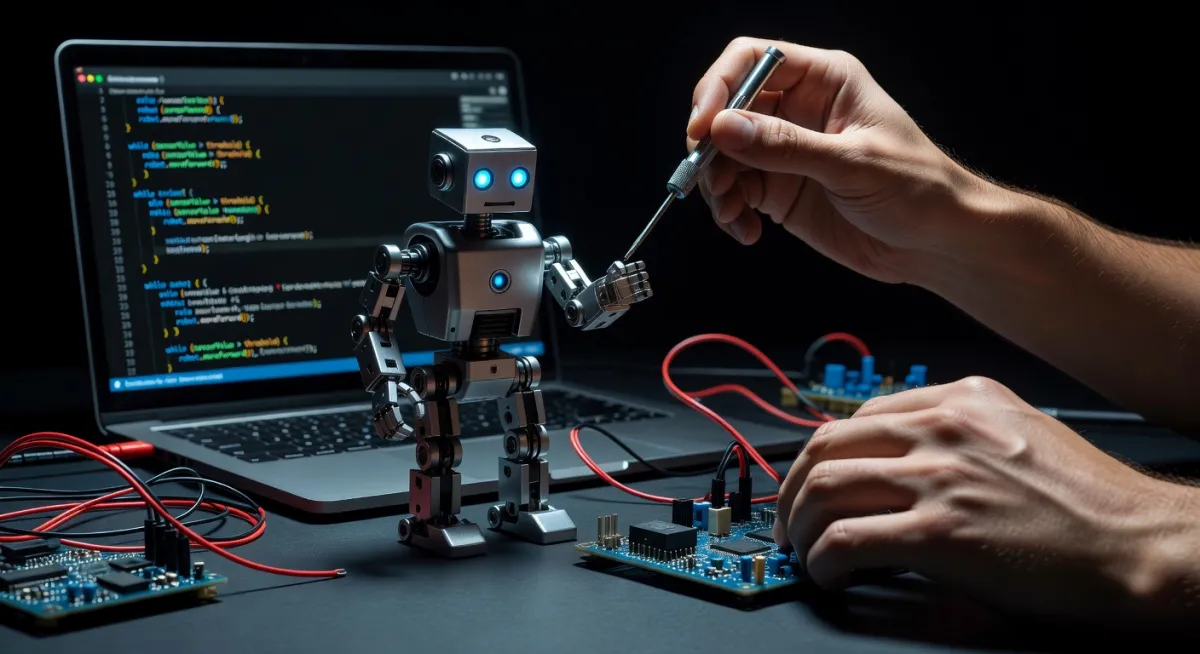
A growing category of robots is designed not just to interact with children but to be programmed by them. These devices — aimed roughly at ages five and up — teach children to construct sequences of commands: "move forward three steps, turn left, make a sound." This is block-based or physical programming, and it introduces computational thinking concepts: sequencing, loops, conditionals, and debugging.
What makes this developmentally distinctive is the immediate, embodied feedback. When a child's program causes the robot to crash into a wall instead of turning the corner, the error is physically visible and often funny. Debugging becomes a genuine puzzle rather than an abstract exercise. The child holds a mental model of what the robot should do, observes what it actually does, and must identify where the model broke down. This is the core of scientific and engineering thinking, practiced through play.
This kind of constructivist, hands-on learning connects naturally to the broader world of STEM kits, where children build systems and observe outcomes — but programmable robots add the dimension of social-seeming agency to that process.
Emotional Intelligence and Empathy Practice
Some of the most carefully designed interactive robots for children display simplified emotional states through visual cues: changing LED eye expressions, posture shifts, or altered movement speeds. When a robot "looks sad," children reliably modify their behavior to comfort it. When it "celebrates," they join in. This is not a trivial response.
Recognizing emotional signals and adjusting behavior accordingly is a foundational component of empathy. Robots provide a forgiving training ground: children can experiment with how different actions affect another being's apparent emotional state without the complexity and stakes of peer relationships. For children who struggle with social emotional learning — whether due to temperament, developmental differences, or limited social experience — this scaffolded practice can be genuinely useful.
Age Considerations: Matching the Robot to the Child
Toddlers and Preschoolers (Ages 2–5)
At this stage, the most valuable robot interactions are simple, highly contingent, and emotionally expressive. A robot that responds to a child's touch with a sound and a wiggle, or that asks a simple question and waits for any verbal response, is appropriately matched to where these children are cognitively. The goal is building the sense of social agency — understanding that you can initiate and influence an interaction — rather than complex skill-building.
Early School Age (Ages 5–8)
This is where robot companions and early programming robots shine. Children this age can hold more complex mental models, tolerate delayed feedback, and begin to understand that the robot follows rules they can learn and manipulate. Turn-taking conversations, simple programming challenges, and robots that ask genuine questions the child must think to answer all work well here.
Older Children (Ages 8–12)
More sophisticated programmable robots, including those that can be coded in text-based languages or that support sensor integration and physical construction, open up genuine engineering and problem-solving territory. The social partner dimension may matter less at this stage than the creative and analytical challenge of building behaviors from scratch and testing them against reality.
Reasonable Cautions and What Robots Cannot Replace
Interactive robots are a supplement to, not a replacement for, human relationships and traditional forms of play. No robot, however sophisticated, replicates the full complexity, unpredictability, and emotional depth of interaction with another person or even a pet. Children still need the full spectrum: rough-and-tumble play with peers, creative open-ended building, outdoor physical experience, and close adult relationships. The value of robot interaction is additive.
Parents should also think about the quality of interaction a given robot actually affords. A robot that is merely loud and visually stimulating without genuine contingency is closer to television than to a social partner. The question to ask is simple: does the robot actually respond differently based on what my child specifically does? If the same flashing sequence plays regardless of the child's input, the "interactive" label is mostly marketing.
The Broader Picture
Children have always recruited objects into their social worlds — dolls, imaginary friends, toy animals endowed with personalities. What responsive robots add to this ancient human habit is feedback. The robot actually does something back. That small shift, from a child projecting a social world onto an inert object to a child negotiating with an object that has its own (simulated) agenda, appears to engage meaningfully different cognitive and social machinery. Developmental science is still mapping precisely how significant those differences are over time. But the underlying mechanisms — contingency, social agency, embodied feedback, cause-and-effect learning — are among the most firmly established drivers of child development we know. In that sense, the interactive robot is a genuinely new kind of toy built on very old principles.