Walk into any nursery section and you'll find toys that light up, sing, count to ten, and cycle through six colors. The implicit promise is that more stimulation equals faster development. But developmental science tells a more nuanced — and more useful — story. When researchers study how infants actually learn from objects, the feature that keeps mattering most isn't novelty, price, or electronic sophistication. It's the physical properties of the object itself: its weight, texture, rigidity, size relative to a small hand, and the way it behaves when dropped, squeezed, or mouthed. Understanding why those properties matter gives parents a genuinely principled way to think about what belongs in a play space during the first twelve months of life.
The Developing Infant Is a Perception-Action Machine
A newborn's brain is not a blank slate waiting to be written on by educational content. It is an active prediction system, constantly building internal models of how the physical world works by testing hypotheses with its body. Every time a baby reaches for an object and either grasps it or misses, every time a rattle produces sound only when shaken in a particular way, every time a soft toy compresses differently from a wooden one — the sensorimotor loop updates its model. This is the foundational insight of ecological psychology and it has enormous practical implications.
The hands, eyes, and brain do not develop independently and then coordinate later. They co-develop through shared experience. The kinds of objects available determine which circuits get exercised, which perceptual distinctions become easy to make, and how quickly motor control matures.

As an Amazon Associate, I earn from qualifying purchases.
The First Three Months: High Contrast and Slow Movement
In the earliest weeks, the visual system is the biggest story. A newborn's visual acuity is limited to roughly 20/400, and the fovea — the central region of the retina responsible for sharp detail — is still maturing structurally. What draws infant attention reliably at this stage is not color complexity but luminance contrast: the boundary between light and dark regions.
This is why simple black-and-white patterns — stripes, concentric circles, checkerboards at the right spatial frequency — hold a newborn's gaze longer than pastel nursery prints. The visual cortex is tuning its contrast sensitivity function, and high-contrast patterns provide the input that function needs to develop properly. Objects with clean, bold edges against contrasting backgrounds are doing real visual work during this window.
Slow, predictable movement matters equally. A mobile hung above a changing table is one of the oldest infant objects for good reason: it teaches the oculomotor system — the muscles and circuits that coordinate smooth eye tracking — to follow a moving target. Smooth pursuit eye movements are a distinct skill from saccades (the rapid jumps eyes make between fixation points), and they require practice with objects that move slowly enough for the immature system to follow.
Three to Six Months: The Hand Becomes an Instrument of Knowledge
Around three to four months, reaching becomes intentional rather than reflexive, and this transforms the toy question entirely. The hand is now an exploratory organ, and what matters most is giving it genuinely varied surfaces and mechanical properties to work with.
As an Amazon Associate, we earn from qualifying purchases.
Why Texture Is Not Decorative
The skin of the hand — particularly the fingertips and palm — is densely packed with four distinct types of mechanoreceptors, each responding to different qualities of touch: light pressure, deep pressure, vibration, and stretch. These receptors need varied input to develop their discriminative sensitivity. A hand that only ever encounters smooth plastic is receiving a narrow slice of the available signal space.
Objects with varied surface textures — silicone nubs, woven fabric, smooth wood, crinkled material — activate different receptor populations. This isn't merely pleasant sensory variety; it is building the haptic library that will later allow the child to identify objects by touch alone, grip tools correctly, and eventually handle small objects with precision.
Weight and Resistance
Proprioception — the sense of force and position in muscles and joints — is trained by resistance. Lightweight foam objects that move with almost no effort give the motor system minimal information to calibrate against. Objects with a little genuine weight, or that require sustained grip pressure to hold (like a silicone ring that deforms when squeezed), force the motor system to solve a real control problem. The infant learns to modulate grip force relative to object weight, a skill with lifelong utility.
Natural materials like wood and solid rubber tend to have more honest weight-to-size ratios than hollow plastic, which is one practical reason developmental toy designers have returned to them.
Six to Nine Months: Causality, Permanence, and the Physics of Containers
By mid-year, the infant is working on something cognitively profound: understanding that objects continue to exist when out of sight, and that actions have predictable physical consequences. These are not abstract intellectual achievements — they are built through repetitive, hands-on interaction with objects that behave consistently.
What Simple Cause-and-Effect Objects Actually Teach
A toy that produces the same response every time a specific action is performed — a ball that rolls when pushed, a rattle that sounds only when shaken — teaches causal contingency. The infant is discovering that their own action caused the effect, which is also the foundation of agency and self-efficacy. The simplicity here is a feature: if the toy responds in complicated or variable ways, the causal mapping is obscured and learning is harder.
Electronics often undermine this by introducing too many response pathways. A button that sometimes plays a song, sometimes lights up, and sometimes does both provides a richer stimulus but a murkier causal lesson. The physical predictability of a well-made mechanical toy — a ball that always rolls, every time, under the same conditions — is doing cleaner pedagogical work.
Containers and the Object Permanence Problem
Simple nesting cups, bowls that fit inside each other, and boxes with lids are among the most cognitively rich objects available to this age group — not because they are educational in any formal sense, but because they create problems that are exactly at the edge of current competence. Dropping an object into a container and watching it disappear exercises object permanence. Trying to nest cups of different sizes requires size discrimination and spatial reasoning. None of this requires labeling, instruction, or electronic prompting.
Nine to Twelve Months: Fine Motor Precision and the Pincer Grasp
The emergence of the pincer grasp — using the tip of the index finger and thumb to pick up small objects — is one of the landmark motor achievements of the first year. It requires independent finger control, which develops through practice with objects small enough to demand it but not so small they are a choking hazard.
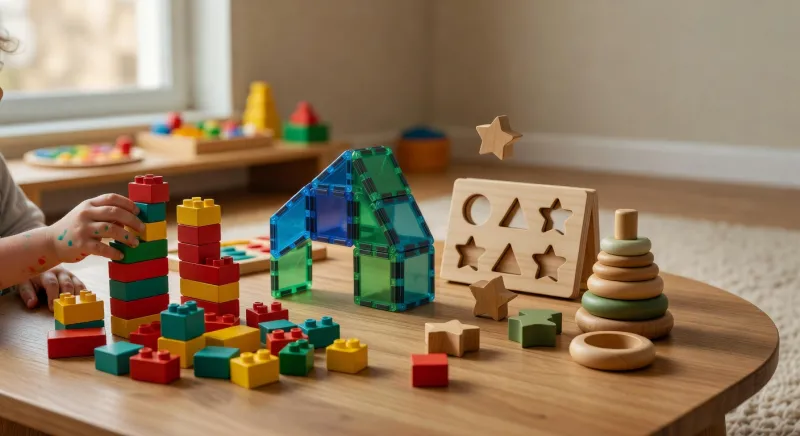
Wooden pegs that fit into holes, small soft blocks that can be stacked (and repeatedly knocked down), and simple shape-sorting challenges all place appropriate demands on the fine motor system at this stage. The act of placing a shape into a corresponding hole involves visual-motor integration: the eyes must guide the hand, calibrating the approach trajectory in real time. This is the same neural pathway that will later be used for writing, drawing, and tool use.
Simple Balls Deserve More Credit
A plain ball — smooth or textured, soft or firm — is one of the most complete developmental objects available across the full first year and well beyond. It provides unpredictable rolling trajectories that train visual tracking, it invites reaching and grasping at variable approach angles, it gives proprioceptive feedback when squeezed, and it creates a natural social loop when rolled back and forth with a caregiver. The variety of sizes available across balls and sports equipment means the same category of object can be calibrated to the changing grip size and motor capacity of a growing infant.
What About Faces, Voices, and Social Objects?
No discussion of infant perceptual development is complete without acknowledging that the most powerful developmental input available to a baby is another human being. The infant brain has dedicated circuitry for face processing that is active from birth, and the auditory system is tuned specifically to the frequency range of the human voice. No manufactured object can replicate or replace this.
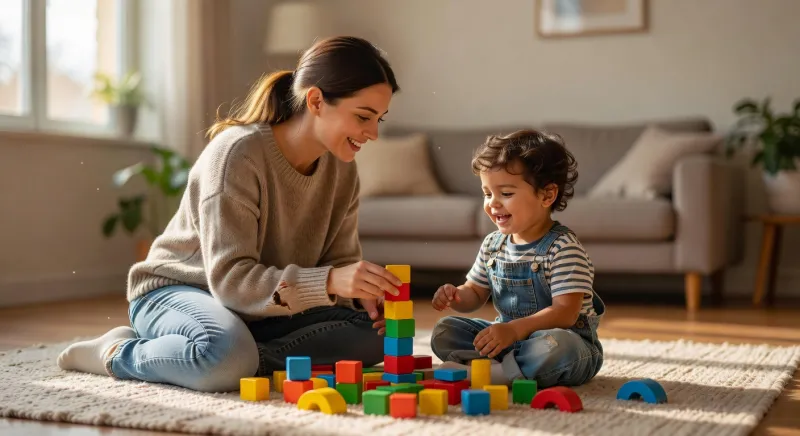
This has a practical implication for toy selection: the most developmentally effective toy is often the one that prompts a caregiver to interact with the baby rather than one that independently entertains the baby. A simple object that a parent picks up, names, hands over, and reacts to is embedded in a rich social-communicative context that builds vocabulary, theory of mind, and emotional security alongside physical skills.
Mirrors (the unbreakable, fabric-backed kind designed for infant use) are interesting precisely for this reason — they don't replace social interaction but they do provide the face-processing system with extended practice material, and infants find them reliably compelling across cultures.
The Honest Case Against Complexity
Electronic toys with multiple modes, sounds, lights, and characters are not harmful in any simple sense. But there is a real cost to over-stimulating the environment: when a toy provides its own entertainment, the infant's role shifts from active problem-solver to passive audience. The reaching, mouthing, turning, banging, and dropping that look like random play are actually systematic physical experiments. Objects that respond in loud, complex, attention-capturing ways can interrupt that experimental loop by hijacking attention before the infant has finished processing what their own action produced.
Simpler objects also leave more room for the infant to determine the pace and direction of exploration — a form of autonomy that itself has developmental value. There is strong reason to believe that intrinsically motivated exploration (doing something because it is interesting) builds deeper and more flexible knowledge than exploration that is prompted or rewarded by external stimuli.
Practical Guidelines by Age
0–3 Months
- High-contrast black-and-white patterns (books, cards, or fabric panels placed within 20–30 cm of the face)
- Slow-moving mobiles with distinct shapes
- Unbreakable mirrors
- Soft objects with varied textures for mouthing and palmar grasping
3–6 Months
- Lightweight rattles with honest cause-and-effect (shake = sound)
- Teething rings in silicone, rubber, and wood for haptic variety
- Crinkle toys and fabric objects with surface texture variation
- Objects of slightly varied weight for proprioceptive calibration
6–9 Months
- Nesting cups and simple containers with lids
- Soft balls of different sizes and surface textures
- Simple cause-and-effect toys with single, consistent responses
- Objects safe for banging together (exploring sound production through impact)
9–12 Months
- Shape sorters with a small number of simple shapes
- Stacking rings or soft blocks
- Peg puzzles with large, easy-to-grip pegs
- Push toys that support pulling to stand and early walking
The Bottom Line
The science of infant perceptual development points toward a counterintuitive conclusion: the best toy for a baby is usually the simplest one that creates the right physical challenge for the current developmental moment. Weight, texture, size, and mechanical predictability are the variables that matter. Novelty, electronic complexity, and educational labeling are largely irrelevant to the core developmental work happening in year one.
Parents who understand this can make choices with genuine confidence — not because they've followed a brand's developmental claims, but because they understand what their infant's hands, eyes, and brain are actually trying to learn.