Hand a one-year-old a board game and watch what happens. She'll mouth a piece, bang another against the floor, and lose interest in under a minute. Hand a four-year-old the same game and she'll invent her own rules, recruit a stuffed animal as an opponent, and play for twenty minutes. Neither child is doing it wrong — they're doing exactly what their developing brain is equipped to do. The disconnect isn't the game. It's the timing.
The developmental stages of play in early childhood aren't a loose ladder children climb at their own pace. They're a fairly predictable sequence tied to neurological maturation, language acquisition, and the slow emergence of social cognition. When play opportunities match that sequence, children gain skills they genuinely couldn't access any other way. When they don't, the activity becomes noise — processed but not integrated.
The Framework: Where the Stages Come From
Most of the modern understanding of play stages traces back to the sociologist Mildred Parten, who in the early 1930s observed nursery-school children and identified a progression in how they engaged with peers — from playing entirely alone, to playing alongside others without interacting, to genuinely cooperative play with shared goals. Later researchers layered in cognitive dimensions: the distinction between functional play (repetitive sensorimotor action), constructive play (building or making), dramatic play (pretend and role assumption), and games with rules.

As an Amazon Associate, I earn from qualifying purchases.
What makes this framework useful isn't the category names — it's understanding why each stage appears when it does, and what it's actually building in the child's mind.
Birth to Twelve Months: Sensorimotor Play and the Discovery of Cause and Effect
In the first year, play is entirely about the body and its effects on the immediate world. Infants don't play with objects so much as they investigate them through every sensory channel available: mouthing, shaking, dropping, staring. This isn't randomness. It's hypothesis-testing at the most fundamental level.
The core cognitive work happening here is the construction of what psychologists call object permanence — the understanding that things continue to exist when out of sight — along with rudimentary cause-and-effect reasoning. A rattle shaken produces a sound. A cup dropped from a highchair produces a spectacular parental reaction. These loops of action and consequence are the raw material from which later, more sophisticated reasoning will be built.
This is why elaborate structured toys designed for older children do essentially nothing useful for an infant. The infant's brain isn't yet asking the questions those toys are designed to answer. What does work at this stage: objects with varied textures, things that make sounds when acted upon, faces (especially caregiver faces), and simple back-and-forth social games like peek-a-boo — which, far from being trivial, rehearses object permanence and early turn-taking in a socially charged context.
As an Amazon Associate, we earn from qualifying purchases.
Twelve to Twenty-Four Months: Functional Play and the First Symbolic Steps
Around the first birthday, something shifts. Children begin repeating actions not just to explore an object but because the repetition itself seems satisfying — pushing a car back and forth, stacking and toppling blocks, filling and emptying containers. This is functional play, and it's the foundation of procedural learning: doing a thing repeatedly until the motor pattern is owned.
But the genuinely significant development in this window is the emergence of symbolic function — the ability to let one thing stand for another. By around eighteen months, most children will hold a banana to their ear and pretend it's a phone, or feed a doll with an empty spoon. This might look like cute imitation, and in part it is. But it's also a cognitive milestone of the first order: the child has understood that a symbol can represent something it is not.
This capacity is the same one that later underlies language (words are symbols), mathematics (numerals are symbols), and reading (letters are symbols). Play at this stage that supports symbolic thinking — simple pretend scenarios, naming games, early blocks and bricks that can become "a tower" or "a house" — is quietly building the representational infrastructure for almost every academic skill that follows.
Two to Three Years: Parallel Play and the Social Apprenticeship
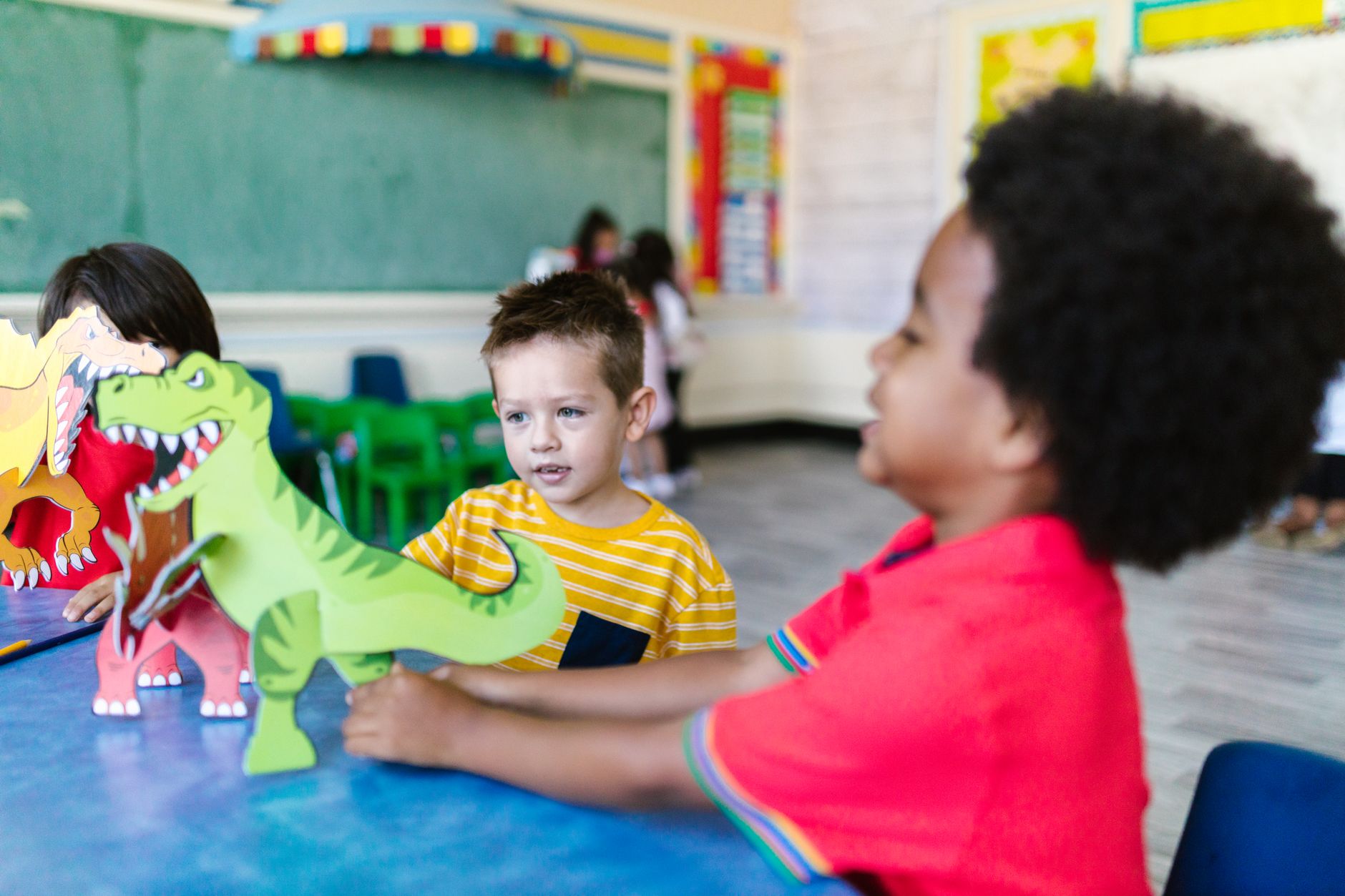
Watch two two-year-olds in a room together and you'll notice something odd: they may play near each other, using the same materials, clearly aware of each other — but largely not with each other. This is Parten's parallel play, and it's frequently misread by adults as a failure of social development. It isn't.
Parallel play is a form of low-risk social apprenticeship. The toddler is observing a peer, registering what that peer does with materials, and sometimes borrowing ideas — all without the cognitive and emotional demands of coordinating intentions with another person. It's watching and learning while maintaining independence. Children at this stage lack the theory of mind (the understanding that others have different knowledge and desires) needed to sustain genuine cooperative play. Parallel play is the socially appropriate behavior for this developmental moment, not a deficit.
Pushing toddlers at this stage into structured group activities with rules and shared roles tends to produce frustration rather than learning, because the cognitive prerequisite — understanding and coordinating with another's intentions — simply isn't fully available yet. What is available: rich individual exploration alongside peers, access to similar materials, and gentle adult modeling of sharing and turn-taking as a scaffold rather than an expectation.
Three to Four Years: Dramatic and Associative Play — When Pretend Gets Serious
Somewhere between three and four, play undergoes a qualitative transformation. Children begin constructing sustained pretend scenarios — not just pretending a banana is a phone, but building entire narrative worlds. The living room becomes a hospital. A cardboard box becomes a spaceship. The child isn't just the astronaut; she's also the director, the screenwriter, and the costume designer.
This is dramatic play, and the research consensus on its developmental value is unusually strong. Fantasy play of this kind exercises what developmental psychologists call executive function — the cluster of skills including working memory, cognitive flexibility, and inhibitory control that predict academic and social outcomes across childhood and into adulthood. When a child plays "restaurant," she must hold the scenario's rules in mind, resist acting outside her assigned role, and flexibly respond when the narrative takes a turn. These are demanding cognitive operations dressed in imaginative clothing.
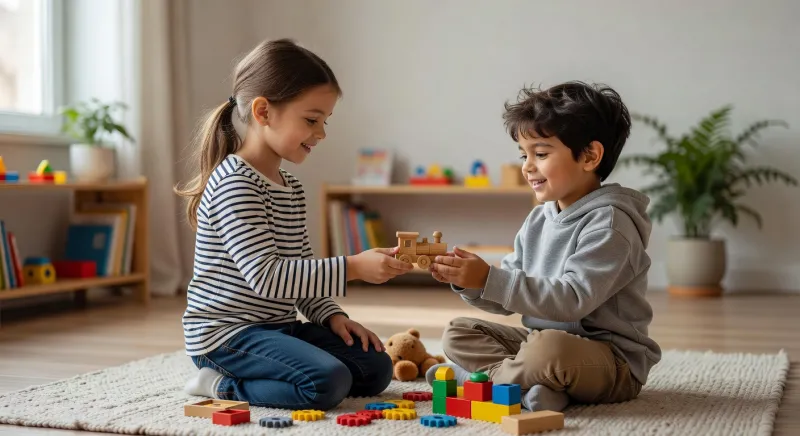
Socially, this is also when associative play emerges — children playing the same activity and talking to one another, trading materials and ideas, but without fully coordinated roles or shared goals. It's the immediate precursor to cooperative play, and it's where children practice the verbal negotiation of shared reality: "Okay, you be the patient and I'll be the doctor." That negotiation is genuinely complex pragmatic language work.
Materials that support open-ended narrative construction — dress-up items, simple props, unstructured spaces — tend to generate longer and more cognitively rich play episodes at this age than highly scripted toys with predetermined functions. The child's imagination provides the structure; the materials just furnish the world.
Four to Five Years: Cooperative Play and the Emergence of Rules
By the fourth or fifth year, cooperative play becomes genuinely possible. Children can now sustain shared goals across an extended period, assign and accept differentiated roles, and — critically — create and follow agreed-upon rules. This last capacity represents the culmination of years of social-cognitive development. Following a rule means understanding that an abstract constraint applies to you even when breaking it would be advantageous, which requires both inhibitory control and a working understanding of shared social contracts.
It's no coincidence that this is when simple board games, group dramatic play with real role division, and organized physical games with rules become genuinely engaging rather than frustrating. The cognitive architecture to support those activities has finally come online.
Preschoolers at this stage also begin using play to process and represent social complexity they've observed: hierarchy, fairness, exclusion, authority. The play scenarios children construct at four and five are not just entertainment — they're rehearsal spaces for navigating a social world that is becoming rapidly more complex.
Why Mismatch Costs More Than It Seems
The intuition that "more advanced" play opportunities must accelerate development is widespread and almost entirely wrong. When a child is given an activity for which the prerequisite cognitive structures aren't yet in place, two things tend to happen. Either the child ignores or misuses the activity (the infant mouthing the board game piece), or the child engages with it in a simplified way that doesn't access the intended learning at all.
Neither outcome is harmful in a single instance. The consistent pattern across years — systematically offering play that races ahead of developmental readiness — creates a subtler problem. It displaces the play the child should be doing. Every hour a three-year-old spends in frustrating pseudo-cooperative structured activities is an hour not spent in the rich dramatic play that is actually the prime developmental opportunity of that exact moment.
The reverse mismatch matters too. Keeping a four-year-old exclusively in solitary, sensorimotor play — offering nothing that invites narrative construction, role-play, or peer engagement — fails to provide the challenges that pull development forward. Play works not when it is far beyond the child's reach but when it sits in what Vygotsky called the zone of proximal development: just challenging enough to require a stretch, but not so far ahead that no internal resources can meet it.
What This Means in Practice
Observe Before You Introduce
The most reliable guide to what play a child is ready for is the play they initiate without prompting. A child who has begun creating elaborate pretend scenarios is telling you that dramatic play is live and active. A child who still mostly explores objects sensorially is telling you the same. Follow the child's spontaneous behavior as your primary signal, not the age range on a box.
Open-Ended Materials Age Well; Scripted Ones Don't
A set of blocks can support functional play at eighteen months, constructive play at three, and elaborate architectural narratives at five. A single-function toy that lights up when a specific button is pressed has a much narrower developmental window. Materials with high open-endedness tend to remain valuable across multiple stages because the child's developing mind creates the appropriate level of challenge from within.
Adult Involvement Should Match the Stage
For infants and young toddlers, the most important play partner is usually a caregiver — responsive, attuned, and emotionally engaging. For three- and four-year-olds in the height of dramatic play, the adult's most valuable role is often providing materials and then stepping back, with occasional participation only when invited. For five-year-olds learning cooperative games with rules, adult modeling of how to handle winning, losing, and rule disputes is genuinely useful. The type of adult involvement that helps isn't constant; it tracks the stage.
Peer Contact Matters More at Some Stages Than Others
Infant play is not primarily social in the peer sense — it's dyadic with caregivers. The value of peer contact rises sharply after age three, when associative and then cooperative play become possible. Engineering extensive peer group time for very young toddlers, while not harmful, is also not the developmental lever it becomes a year or two later.
The Larger Point
Play isn't a single thing that children do more or less of as they grow. It's a sequence of qualitatively different activities, each appearing on schedule as the brain becomes capable of the operations that activity requires, each building the substrate for what comes next. Respecting that sequence — offering the play that fits the moment rather than the play we imagine will accelerate arrival at the next moment — is one of the most consequential and underappreciated things adults can do for children's development. Not because it feels enriching, but because the fit between what a child's brain is ready for and what a child's environment offers is precisely where learning happens.