Watch a four-year-old arrange a handful of plastic animals around a wooden farm, and you might see simple amusement. A developmental psychologist sees something far more interesting: a child practicing one of the most sophisticated cognitive maneuvers a human brain can perform — stepping outside their own physical perspective to inhabit, manage, and reason about a world that exists entirely in miniature. This is the essence of small world play, and its connection to child development and symbolic thinking runs deeper than most parents realize.
What Is Small World Play, Exactly?
Small world play refers to any self-directed activity where a child creates and inhabits a miniaturized scene — a dollhouse, a tray of dinosaurs in sand, a village of wooden figures, a fleet of toy vehicles arranged around a hand-drawn road map. The defining feature is not the specific materials but the cognitive stance the child takes: they become the architect, the narrator, and the god of a tiny universe simultaneously.
This is distinct from other forms of play. In dress-up or role-play, a child becomes a character. In small world play, they control characters from above and outside. That difference — the bird's-eye view, the godlike distance — is precisely what makes it developmentally rich.

As an Amazon Associate, I earn from qualifying purchases.
Symbolic Distancing: The Core Cognitive Mechanism
Developmental psychologists use the term symbolic distancing to describe the mental gap a child must bridge when they treat one thing as standing in for another. A wooden peg becomes a grandmother. A blue piece of cloth becomes an ocean. A shoe box becomes a house. The further that gap — the less the symbol resembles the real thing — the more cognitive work is required to maintain the fiction.
Small world play is one of the richest training grounds for this skill because it demands symbolic distancing on multiple levels at once. The child must accept that the miniature scene represents a real-world space, that the tiny figures represent living agents with intentions and feelings, and that actions performed in the small world have meaning within a narrative logic the child is constructing in real time. Managing all of this simultaneously is genuinely demanding work for a developing brain.
This capacity for symbolic thought underpins an enormous range of later cognitive skills: reading (letters are symbols for sounds), mathematics (numerals stand for quantities), maps and diagrams (two-dimensional marks represent three-dimensional space), and scientific modeling (a diagram of a cell stands in for something too small to see). Children who have practiced symbolic distancing extensively in play tend to find these conceptual leaps more intuitive.
Perspective-Taking and Theory of Mind
One of the most studied milestones in early childhood is the emergence of theory of mind — the understanding that other people have beliefs, desires, and knowledge states that differ from one's own. Children typically begin to demonstrate clear theory of mind understanding around ages three to five, though the roots develop earlier.
As an Amazon Associate, we earn from qualifying purchases.
Small world play quietly rehearses this capacity every time a child gives two figures conflicting goals. When a child makes the small figure "want" to go home while the larger figure "wants" to stay, they are modeling two separate mental states and tracking how each drives behavior. They are, in miniature, doing exactly what theory of mind requires: holding multiple perspectives inside the mind at once without collapsing them into one.
Preschoolers are at a particularly fertile stage for this kind of play. The three-to-five window sees explosive growth in both narrative capacity and social cognition, and small world setups give children a low-stakes arena to practice social complexity — conflict, resolution, hierarchy, fairness — before they encounter it in real relationships.
Systems Thinking in Miniature
When a child builds a small town and begins populating it with figures who have roles — the baker, the firefighter, the family returning home — they are not just playing pretend. They are building a mental model of how a system operates: how its components relate to each other, what happens when one element changes, and how the whole thing depends on each part functioning in a certain way.
This is a genuine introduction to systems thinking, which researchers and educators increasingly identify as a critical skill for navigating complex environments. The child who discovers that their miniature town doesn't "work" because they've placed the hospital too far from the road, and who then reorganizes the layout to fix the problem, has just performed rudimentary urban planning — and learned something about interdependence that no worksheet can teach as viscerally.
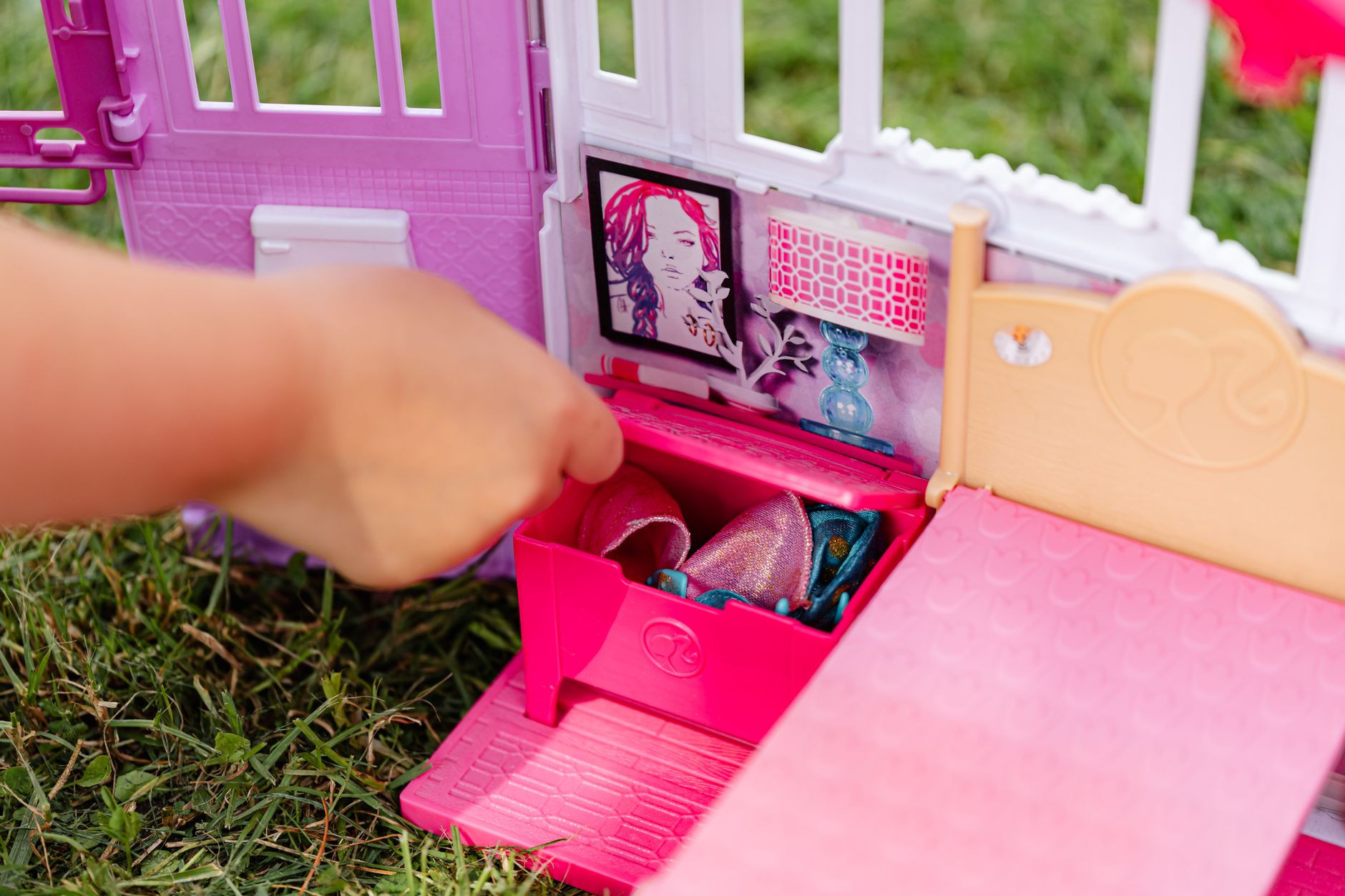
Dollhouses are particularly good at teaching spatial systems. Moving furniture around to make a room "work," understanding that a bathroom needs to be near a bedroom, recognizing that a kitchen needs to connect to a dining area — these are spatial logic problems dressed in play clothes. The child solves them intuitively, building mental frameworks for how spaces are organized that will serve them for life.
Language, Narrative, and the Architecture of Story
Small world play is almost always accompanied by running commentary, dialogue, and narration. Even solitary play tends to generate a stream of language as the child voices characters, announces events, and describes what is happening. This narrative output is far from incidental — it is doing important cognitive and linguistic work.
To tell a coherent story, even a whispered one between two plastic figures, a child must sequence events in time, establish cause and effect, maintain character consistency, and resolve tension. These are the structural elements of all narrative, from picture books to novels. Children who engage heavily in small world play often develop what researchers call narrative competence — the ability to organize experience into story form — earlier and more fluently than those with less exposure to this type of play.
The figures themselves scaffold this process. Having a physical anchor for each character means the child doesn't have to hold the entire cast in working memory; the toys do that work, freeing cognitive resources for the narrative architecture itself.
The Role of Scale: Why Tiny Matters
It might seem arbitrary that the figures are small, but scale turns out to matter psychologically. When objects are miniaturized, they become mentally manageable in a way that full-sized environments are not. The child can see the entire world at once, hold it in a single visual field, and manipulate any part of it without moving from their spot. This overview effect — similar in some ways to the cognitive shift astronauts describe when seeing Earth from orbit — enables a kind of holistic reasoning that is hard to achieve when you are embedded inside a space at full scale.
Researchers have noted that children's ability to use maps and scale models to navigate real spaces develops significantly through this period, and that experience with miniature representations directly supports the ability to translate between map and territory. A child who has spent hours arranging a miniature town is practicing exactly the mental transformation that map-reading requires.
What Good Small World Play Looks Like at Different Ages
Toddlers (Around 18 Months to 3 Years)
Toddlers begin engaging with small world play in its simplest forms: making a toy car go "vroom," feeding a doll, placing a figure inside a toy house and taking it out again. At this stage the symbolic leap is still being constructed — the child is learning that the small object can stand in for the real thing. Simple setups with chunky, recognizable figures are ideal. The play is typically short, exploratory, and highly physical.
Preschool Age (3 to 5 Years)
This is the golden period for small world play. Children this age sustain elaborate narratives, assign complex roles to figures, create rules for the world they are building, and begin incorporating other children into their setups — which adds a powerful social dimension. The cognitive demands ramp up considerably: the child is now managing multiple characters' perspectives, tracking a narrative over time, and solving problems within the logic of their invented world.
School Age (5 to 8 Years and Beyond)
Older children often shift toward more rule-governed versions of small world play — complex pretend play sets with established universes, building systems with logic constraints, or collaborative world-building with peers. The cognitive work becomes more explicit: world-building at this age often involves negotiation, written rules, drawn maps, and self-imposed consistency requirements that are precursors to formal logical thinking.
What Adults Can Do (and What They Should Avoid)
The research on play broadly suggests that adult intervention in child-directed play should be minimal and responsive rather than directive. Small world play specifically benefits from adults who provide rich materials and then step back. The cognitive work happens in the child's decisions — what goes where, who does what, what happens next. An adult who takes over the narrative, corrects the child's arrangements, or insists on realistic outcomes is inadvertently short-circuiting the very processes the play is designed to develop.
What adults can do helpfully is enrich the input: introducing new materials that extend the possibilities of the world, asking open questions that invite the child to elaborate their narrative rather than directing it, and occasionally playing alongside as a responsive collaborator rather than a supervisor. Saying "What does the small one want to do?" is more productive than "The small one should go to sleep now."
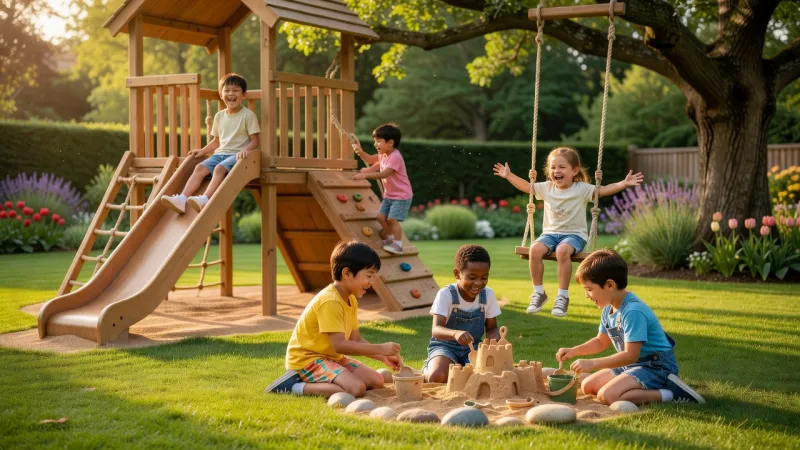
Diversity of materials matters too. Sand, water, clay, fabric, and natural materials like sticks and stones as scene elements add sensory and physical complexity that purely plastic setups can lack. The more varied the materials, the wider the range of problems the child encounters and solves.
The Bigger Picture: Why This Matters Beyond Childhood
The skills practiced in small world play — symbolic thinking, perspective-taking, systems reasoning, narrative construction — are not just preparation for school. They are foundational to adult competencies that are increasingly valued in complex, interconnected environments: the ability to model situations mentally before acting, to understand how changing one variable affects a whole system, to inhabit perspectives other than one's own, and to communicate coherently about cause and effect over time.
In an era when there is significant pressure to accelerate children toward structured academic learning, small world play represents something genuinely difficult to replace: a form of cognitive training that is intrinsically motivated, emotionally engaging, self-paced, and calibrated precisely to the child's current developmental level. The child is always playing at the edge of their capacity, which is exactly where learning happens.
The tiny figures on the floor are doing serious work. They just happen to look like fun.