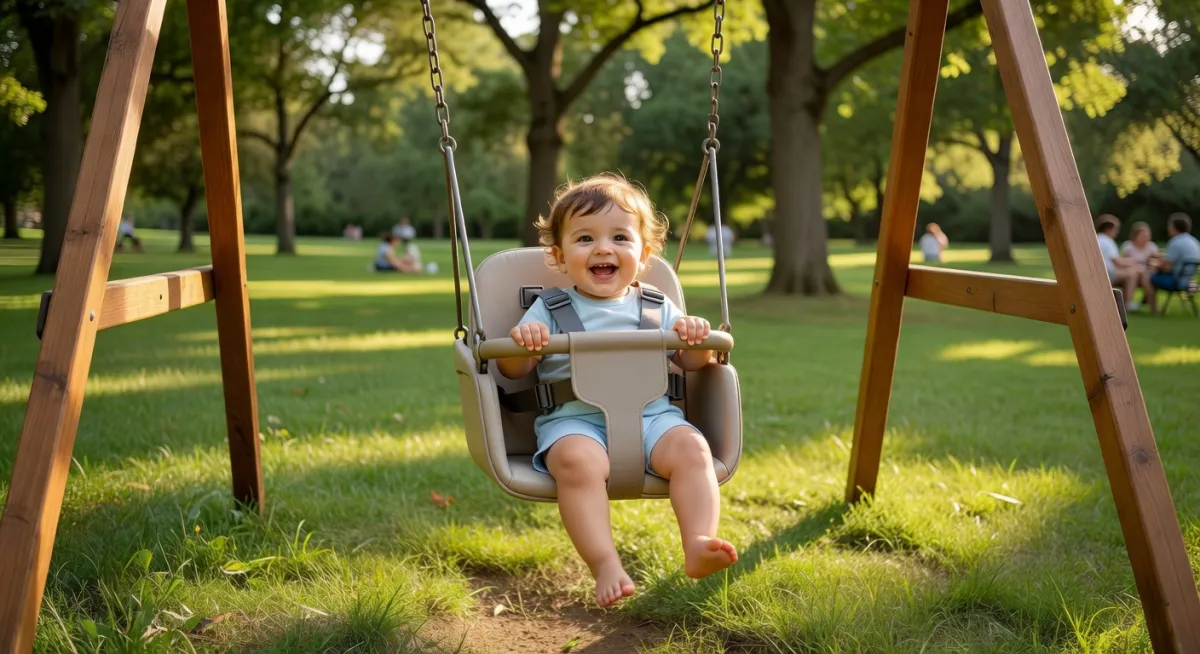
Watch a toddler on a swing and you'll see pure joy. What you won't see — but what is happening in vivid detail — is a cascade of neurological activity that no screen, puzzle, or classroom exercise can fully replicate. Every arc through the air is a training session for systems deep inside the developing brain, systems responsible for balance, body awareness, coordination, and even the ability to sit still and pay attention. So yes, swings are good for toddlers. But the reasons run far deeper than most parents realize.
The Two Sensory Systems a Swing Activates Most Powerfully
To understand what a swing does for a young child, you first need to know about two sensory systems that don't get nearly as much attention as sight or hearing, but are arguably more foundational during early development.
The Vestibular System: Your Child's Internal GPS
The vestibular system lives in the inner ear. Its job is to detect movement through space — acceleration, deceleration, tilt, rotation, and changes in head position relative to gravity. It is one of the earliest sensory systems to develop in utero, and it remains one of the most influential throughout childhood.

As an Amazon Associate, I earn from qualifying purchases.
When a toddler swings, the vestibular system is working hard. Each forward and backward arc sends a stream of information to the brainstem and cerebellum — the regions responsible for coordinating movement, maintaining posture, and calibrating where the body is in space. Repeated, rhythmic vestibular input, exactly the kind a swing provides, strengthens the neural pathways that underpin balance and spatial orientation.
This matters well beyond the playground. Children with well-developed vestibular processing find it easier to track moving objects with their eyes, maintain upright posture at a desk, and navigate through a busy room without bumping into things. Vestibular input also has a direct calming effect on the nervous system — which is why a fussy infant settles when rocked and why swinging tends to leave toddlers in a regulated, focused state afterward.
Proprioception: The Sense You've Never Thought About
Proprioception is the body's ability to sense its own position and movement in space without looking at itself. It relies on mechanoreceptors in muscles and joints that are directly stimulated by the physical demands of gripping, pumping, and balancing on a swing. Every time a toddler tightens their grip on a chain, shifts their weight to maintain balance, or begins to learn the pumping motion that sustains momentum, thousands of these receptors fire simultaneously, feeding the brain a detailed map of where every limb is and what every muscle is doing.
Proprioceptive input is sometimes called "heavy work" in occupational therapy — not because it requires effort in the conventional sense, but because it gives the nervous system rich, grounding feedback. Children who get regular proprioceptive input tend to have better body awareness, which translates into neater handwriting, safer physical play, and a reduced tendency to seek out rough, crashing play as a way of getting the sensory feedback their bodies are asking for.
As an Amazon Associate, we earn from qualifying purchases.
Jean Ayres and the Science of Sensory Integration
Jean Ayres, an occupational therapist and neuroscientist, developed Sensory Integration Theory in the 1970s, describing how the brain organizes sensory input — including vestibular input from swinging — to produce coordinated, adaptive behavior. Her work fundamentally changed how therapists, educators, and eventually parents understood the role of movement-based play in child development.
Ayres argued that the brain is not a passive receiver of sensory information — it actively integrates inputs from different systems to build a coherent picture of the body and its environment. When this integration works well, children move fluidly, learn easily, and regulate their emotions effectively. When it is disrupted — whether by limited movement experiences, developmental differences, or sensory processing difficulties — children may struggle with coordination, attention, and behavior in ways that look puzzling from the outside.
The practical implication is significant: the kinds of play experiences a child has in their early years are not just entertainment. They are the raw material the brain uses to wire its sensory integration circuits. Swings and slides are among the most efficient tools for delivering the vestibular and proprioceptive input that this wiring process depends on.
What Swinging Specifically Builds — Developmental Milestone by Milestone
Core Strength and Postural Control
Sitting upright on a moving swing without toppling requires the deep stabilizing muscles of the trunk — the core — to work constantly and reflexively. For toddlers, who are still developing this muscular control, the swing is essentially a dynamic training environment. The body must make micro-adjustments many times per second to stay balanced, and over time those adjustments become faster, more automatic, and more refined.
Strong postural control is a prerequisite for almost every physical skill that comes later: running without falling, climbing, riding a bike, and eventually sitting at a school desk for extended periods. Children who lack core stability often tire quickly during seated activities and may fidget or slump — not out of disobedience, but because their postural muscles aren't yet capable of sustaining upright posture without conscious effort.
Bilateral Coordination
Once a child is old enough to begin pumping a swing themselves — typically around age four or five, though with significant individual variation — they are learning bilateral coordination: the ability to use both sides of the body in a synchronized, alternating pattern. This is the same skill that underlies walking, climbing stairs, catching a ball, and eventually writing. The swing teaches it through whole-body repetition in a way that is intrinsically motivating — the child wants to go higher, so they keep practicing.
Spatial Awareness and Visual-Vestibular Integration
As a child swings, their visual field moves in sync with their body's arc through space. The brain must continuously reconcile what the eyes are seeing with what the vestibular system is feeling. This cross-referencing — called visual-vestibular integration — is foundational for spatial reasoning, the ability to mentally rotate objects, and reading skills that require the eyes to track smoothly across a page.
Attention Regulation
Perhaps the least obvious benefit of swinging is its effect on attention. The vestibular system has direct connections to the reticular activating system — the brain network responsible for regulating arousal and alertness. Rhythmic, linear vestibular input (like the back-and-forth of a standard swing) tends to be organizing and calming for the nervous system, shifting children toward a state of focused alertness that is optimal for learning.
This is why occupational therapists working with children who have attention difficulties often incorporate swinging into their sessions. The effect isn't sedation — it's regulation. Children emerge from swinging more ready to engage, not less.
Slides: A Different Kind of Vestibular Input
Slides deserve mention alongside swings because they deliver a distinct vestibular experience. The rapid linear acceleration of sliding downward, combined with the transition from standing to seated to moving, challenges the vestibular system in ways that complement what a swing provides. The brief moment of uncertainty at the top — will I go? how fast? — also engages the amygdala and prefrontal cortex in low-stakes risk assessment, building the neural circuitry for managing mild fear and uncertainty.
Together, swings and slides create a natural sensory curriculum that is difficult to replicate indoors. For toddlers especially, whose brains are in a period of explosive neural development, regular access to this kind of equipment is meaningfully different from other forms of play.
How Much Time on the Swing Is Beneficial?
There is no clinically established minimum dose, but occupational therapists generally recommend that young children have access to movement-rich outdoor play — including swinging — daily, or as close to daily as is practical. Even short sessions of ten to fifteen minutes provide meaningful vestibular and proprioceptive input. What matters more than duration is regularity and variety: the brain benefits from consistent exposure to movement experiences over time, not occasional intense bouts.
It's also worth noting that the benefit is not automatic — it requires the child to be actively engaged, not just passively pushed. As children get older, encouraging them to pump themselves, to try different body positions (leaning back, sitting up straight, twisting slightly), or to coordinate with a partner introduces new sensory challenges that keep the developmental gains accumulating.
A Note on Children with Sensory Processing Differences
Some children are hypersensitive to vestibular input and find swinging overwhelming or frightening. Others are hyposensitive and seem to crave constant spinning or swinging in a way that seems insatiable. Both patterns can be signs of sensory processing differences that an occupational therapist can assess and support. For these children, the playground is still valuable — but the approach may need to be modified, with gradual exposure for those who are sensitive, and structured rather than unlimited swinging for those who find it hard to stop.
If a child consistently refuses swings, becomes unusually distressed by movement, or seems unable to self-regulate after vigorous swinging, it's worth mentioning to a pediatrician or occupational therapist — not because there is necessarily a problem, but because early support for sensory processing differences can make a significant difference.
The Simple Takeaway
A swing set is not a luxury or a distraction from more "educational" activities. It is, in the most literal neurological sense, a learning tool — one that activates ancient sensory systems, builds the physical foundations of coordination and attention, and gives the developing brain exactly the kind of rich, embodied input it is designed to seek out and use. The child laughing at the top of each arc has no idea any of this is happening. That's fine. The brain knows.
Sources
Every factual claim in this article was independently verified against the following sources:
- Anna Jean Ayres — en.wikipedia.org
- Proprioception — en.wikipedia.org