You've read the same picture book eleven times this week. Your toddler has asked you to rebuild the same block tower just so she can knock it down — again. Your five-year-old has assembled the same puzzle every single morning for a month. If your instinct is to gently redirect them toward something new, you might want to pause. What looks like stubbornness, limited imagination, or even boredom is almost certainly none of those things. Repetitive play in child development is one of the most powerful learning mechanisms the young brain has at its disposal.
The Brain Under Construction
To understand why children repeat, it helps to understand what is happening inside their heads. In the early years of life, the brain is undergoing a period of extraordinary synaptic growth and pruning. Neurons form connections at a breathtaking rate, but connections that are used repeatedly become stronger and more efficient — a process neuroscientists describe informally as "neurons that fire together, wire together." Every time a child repeats an action, a story, or a game, they are literally reinforcing neural pathways. Repetition is not the enemy of learning; it is the mechanism of learning at the neurological level.
This is why the same activity that bores an adult — who already has a well-worn neural pathway for it — feels genuinely fresh and productive to a child who is still building that pathway. They are not experiencing the tenth read-aloud the way you are. They are getting measurably better at something each time.
As an Amazon Associate, I earn from qualifying purchases.
What "Mastery" Actually Looks Like in Play
Developmental psychologists have long noted that children move through play in a progression from exploration to mastery. During the exploration phase, a child is asking: "What does this do?" During the mastery phase, they are asking something more demanding: "What can I make this do, reliably, every time?" Repetitive play is the engine of that second question.
Watch a toddler carefully the fifth time they knock over a tower and you will notice something: they are not doing exactly the same thing. They might hit it from a different angle, use a different block as the base, or observe where the pieces land with intense curiosity. The activity is the same; the experiment inside it is constantly evolving. This is incremental, self-directed problem-solving disguised as mindless repetition.
Procedural Memory and Skill Consolidation
Psychologists distinguish between declarative memory — knowing facts — and procedural memory, which is knowing how to do things. Procedural memory is built almost exclusively through repetition. When a child insists on pouring their own water, tying their own shoes, or completing the same shape-sorting activity day after day, they are consolidating a motor and cognitive procedure. This is identical, neurologically, to how a musician learns a scale or an athlete learns a serve. The only difference is scale and context.
Cutting short a child's repetitive play before they have reached their own internal sense of mastery is a bit like interrupting a musician mid-scale. The learning is disrupted before the consolidation is complete.
As an Amazon Associate, we earn from qualifying purchases.
Emotional Safety and the Predictable World
Repetition in play is not only about skill acquisition. It also serves a profound emotional function. Young children live in a world that is largely unpredictable and controlled by others. They cannot choose when to eat, when to leave a place they are enjoying, or when a loved one will come home. In this context, an activity or story that always unfolds the same way is deeply comforting. The child knows what happens next. They are in control of the outcome.
This is particularly visible in children's relationship with stories. When a child demands the same book again and again, part of what they are doing is rehearsing a narrative arc they already understand, confirming that the world of that story is reliable. Research in early literacy consistently shows that repeated readings of the same text deepen comprehension, vocabulary acquisition, and narrative understanding — children notice new details, absorb language patterns, and make richer inferences on later readings than on the first.
Processing Difficult Experiences Through Repetition
Developmental theorists, drawing on the foundational work of figures like Jean Piaget and later play researchers, have noted that children often use repetitive play to work through experiences that confused or unsettled them. A child who has recently visited a doctor's office may replay the scenario repeatedly in pretend play — not because they cannot think of anything else, but because they are metabolizing an experience that felt large and uncertain. Each repetition gives them a chance to be the one in control, to understand the sequence, and to reach emotional resolution. This is adaptive, not avoidant.
Repetition Across Different Types of Play
Physical and Sensorimotor Play
For toddlers and young children, repetitive physical play — climbing the same structure, sliding down the same slide, throwing a ball against the same wall — is how the body calibrates itself. The vestibular and proprioceptive systems depend on repeated physical input to refine balance, coordination, and spatial awareness. A toddler who goes down the slide forty times in a row is running a sophisticated sensorimotor calibration program. Their body is learning to predict and manage forces, distances, and movements with increasing accuracy.
Constructive and Symbolic Play
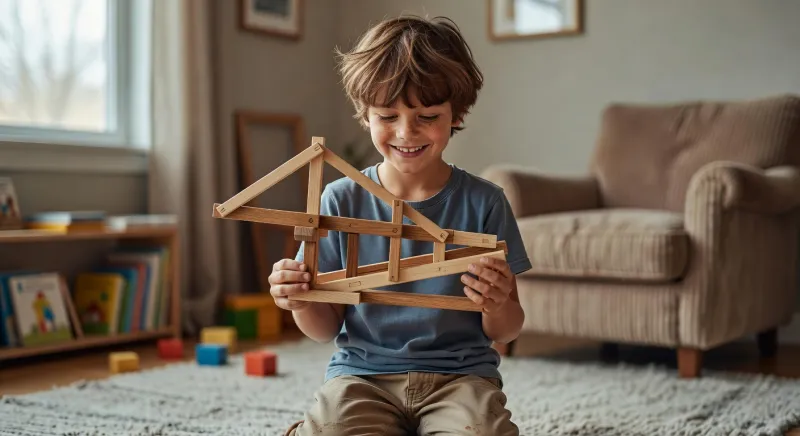
Building the same structure with blocks or assembling the same puzzle repeatedly allows children to test hypotheses about spatial relationships, cause and effect, and problem-solving strategies. On the third or fourth attempt, a child might try a different approach because the first one was unstable. This iterative process is structurally identical to scientific thinking — forming a hypothesis, testing it, observing the result, and refining the approach. The repetition is what makes the comparison between attempts meaningful.
Narrative and Pretend Play
When children replay the same scenario in pretend play — the same birthday party, the same rescue mission, the same cooking sequence — they are rehearsing social scripts. These mental scripts are cognitive frameworks that help children understand how social interactions are structured, what sequences of events mean, and how cause and effect operate in human relationships. Repetition deepens and refines these scripts in ways that a single exposure never could.
When Should Parents Be Curious Rather Than Concerned?
Most repetitive play is healthy and developmentally useful. However, it is worth knowing the features that distinguish typical repetitive play from patterns worth discussing with a pediatrician or developmental specialist. Typical repetitive play is flexible — the child can be redirected when necessary and does not become significantly distressed if the routine is gently interrupted. The play generally incorporates variation over time, even if the overarching structure stays the same. The child shows genuine pleasure and engagement during the activity.
Repetitive behaviors that are highly rigid, escalate in intensity when interrupted, show no variation whatsoever over long periods, or appear to exclude other forms of social engagement are worth raising with a professional — not because repetition itself is a problem, but because extreme inflexibility around any behavior can sometimes signal that a child would benefit from additional support.
What Parents Can Do: Supporting Rather Than Redirecting
The most useful thing a parent or caregiver can do during a child's repetitive play is to be present without taking over. Ask genuine questions — "What do you think will happen this time?" — rather than suggesting variations. Narrate what you observe: "You put the big piece in the corner again. That made it stronger last time, didn't it?" This kind of sportscasting builds language and metacognitive awareness without hijacking the child's internal process.
When you do introduce a new variation, frame it as a possibility rather than a correction. "I wonder what would happen if..." is an invitation. "Let's try something different" is often heard as an interruption of important work — because, from the child's perspective, that is exactly what it is.
It is also worth resisting the cultural pressure to equate novelty with enrichment. There is a widespread assumption that good parenting means constantly offering new experiences, new toys, and new stimulation. The developmental science suggests a more nuanced picture: novelty is valuable, but so is depth, and depth requires repetition. A child who returns to the same activity across days and weeks is not stuck. They are going deeper.
The Long View
The habits of mind that repetitive play builds — persistence, incremental refinement, comfort with process, the ability to find meaning in the familiar — are not just useful in childhood. They are the foundations of expertise in any domain. Every adult who has developed a genuine skill in anything knows that mastery comes not from doing many different things once, but from doing the same things many times with increasing intentionality. Children arrive at this understanding intuitively, and they practice it daily, if we let them.
The next time your child hands you the same book for the twelfth consecutive night, consider that they are not failing to move on. They are doing exactly what their developing brain needs them to do: going back to go deeper, building something that will last.